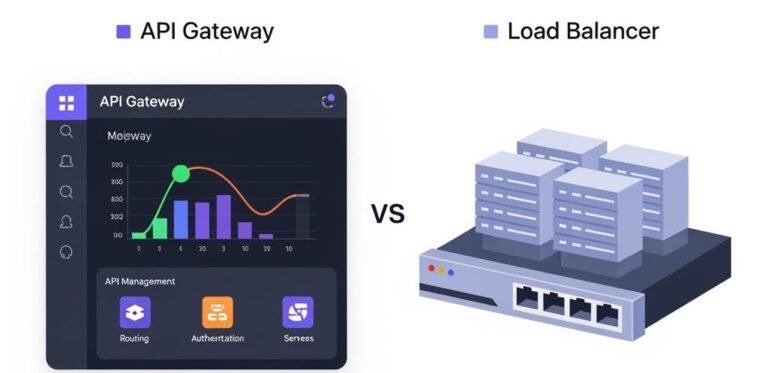
1. What is a Load Balancer?
Definition:
A Load Balancer distributes incoming traffic across multiple servers to prevent any one server from being overwhelmed.
How It Works:
Analogy:
Imagine a pizza delivery kitchen with multiple chefs. The manager (load balancer) assigns orders to different chefs. If one chef is unavailable, the manager reroutes the orders.
Use Cases:
-
✔ High-traffic websites (Netflix, Amazon)
-
✔ Scaling apps to handle more users
-
✔ Ensuring uptime and availability
Types of Load Balancers:
-
Application Load Balancer (ALB) – HTTP/HTTPS traffic
-
Network Load Balancer (NLB) – TCP/UDP traffic
-
Classic Load Balancer (CLB) – Legacy option
Real-World Example:
When you access Facebook, a load balancer decides which server processes your request.
2. What is an API Gateway?
Definition:
An API Gateway acts as a traffic controller for APIs—routing, authenticating, and managing requests between clients and backend services.
How It Works:
Analogy:
Like a hotel concierge, an API Gateway accepts your request and sends it to the right service, checks your identity, and may modify the response.
Use Cases:
-
✔ Microservices management
-
✔ Authentication (OAuth, JWT)
-
✔ Request/response transformation (JSON ↔ XML)
Real-World Example:
When you use Uber, your app’s request (e.g., “Find a ride”) goes to an API Gateway, which routes it to the right internal service like pricing or maps.
3. Key Differences: API Gateway vs Load Balancer
| Feature |
Load Balancer |
API Gateway |
| Role |
Distributes server traffic |
Manages & routes API requests |
| OSI Layer |
Layer 4 or 7 |
Layer 7 |
| Protocol Support |
HTTP, TCP, UDP |
HTTP, HTTPS, WebSocket |
| Security |
Basic (SSL) |
Advanced (Auth, Rate Limits) |
| Common Use |
Scalability |
Microservices Management |
| Tools |
AWS ALB, Nginx, HAProxy |
AWS API Gateway, Kong, Apigee |
4. When to Use Each?
Use a Load Balancer When:
-
You need high availability and fault tolerance
-
Your app has multiple backend servers
-
You want to distribute traffic evenly
Use an API Gateway When:
-
You use microservices with different APIs
-
You need security features like JWT/OAuth
-
You want to log, throttle, or transform requests
5. Can They Work Together?
Yes! Many modern architectures use both for optimal efficiency.
Example – E-Commerce App:
-
API Gateway: Handles login, cart, and payment routing.
-
Load Balancer: Balances traffic among checkout servers.
6. Common Mistakes to Avoid
❌ Using a Load Balancer as an API Gateway – lacks API-level controls
❌ Using an API Gateway for raw TCP/UDP – not designed for low-level traffic
❌ Not scaling both – bottlenecks can still happen
7. Final Verdict: Which One Do You Need?
| Scenario |
Best Choice |
| Scaling web traffic |
Load Balancer |
| Managing multiple APIs |
API Gateway |
| Need authentication or rate limiting |
API Gateway |
| Basic server distribution |
Load Balancer |
💡 Key Takeaway:
-
Load Balancer = Traffic Cop → directs traffic evenly to servers.
-
API Gateway = Smart Router → manages, filters, and transforms API calls.
For robust, scalable systems, use both together!